PaletteAI Inference Launchpad Architecture Overview
This page explains how PaletteAI Inference Launchpad works, how its components interact, and what key decisions shaped the design. Use this page to build an understanding of the architecture before you deploy or operate PaletteAI Inference Launchpad.
Component Stack
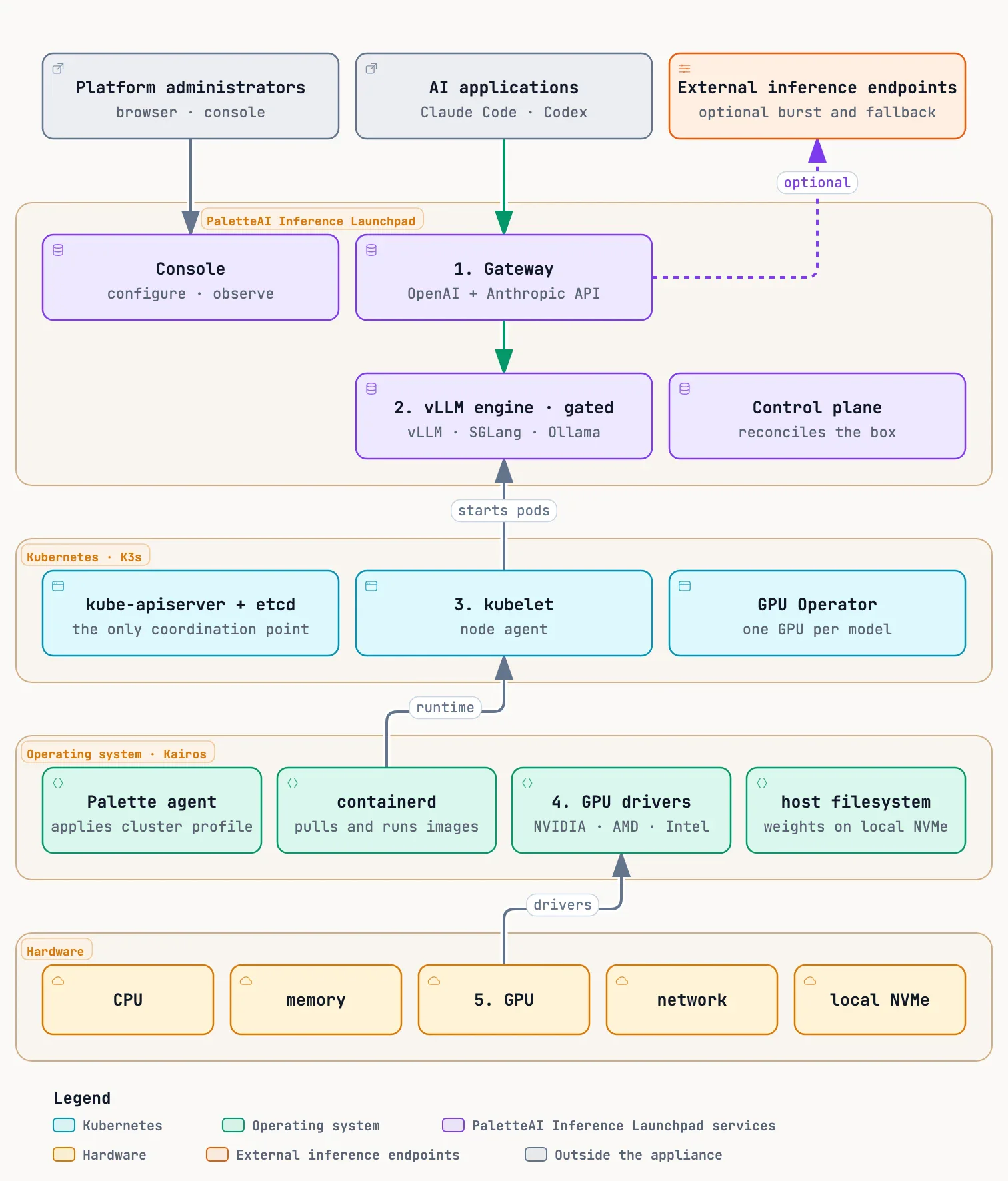
The following diagram shows the appliance as a stack of four layers, where each layer runs on the layer below it. The numbers follow a request from an AI application down to the GPU, and they match the list after the diagram.
-
AI applications, such as Claude Code, Codex, Cursor, and OpenCode, send their requests to the gateway through the Platform IP. The gateway serves the OpenAI-compatible and Anthropic Messages APIs. It authenticates each client, enforces the client's quotas, and routes each request to a model. Refer to Request Routing and Network Topology.
-
The vLLM engine serves the model that the gateway chose. Refer to Model Placement.
-
Kubernetes runs the engine as a pod. The kubelet on the node starts the pod, with containerd as its runtime, and the GPU Operator makes the GPUs available to it.
-
The GPU drivers in the operating system let the engine use the GPUs.
-
The model runs on the appliance's GPUs. For how to size the GPUs, refer to Hardware Sizing.
When a platform administrator allows egress, the gateway can send a request to an external inference endpoint instead of a local model. Egress is off by default. An endpoint is either a built-in one for Anthropic, OpenAI, or Gemini, or an OpenAI-compatible host that a platform administrator registered. Refer to External Inference Endpoints and Data Residency and Isolation.
Platform administrators open the console in a web browser to configure the appliance and observe how it is used. The control plane, which is separate from the Kubernetes control plane, keeps the appliance in line with the settings that platform administrators save for models, clients, and policies. Refer to Model Provisioning Lifecycle.
The lower layers hold the parts that every service relies on. In Kubernetes, the API server, backed by etcd, is the one place where the appliance's components coordinate. The operating system is Kairos, an immutable Linux distribution. In it, the Palette agent applies the appliance's cluster profile, and model weights live on the host filesystem, on local NVMe storage.
The appliance serves each model through an inference engine, such as vLLM, running on its Kubernetes cluster. Each
loaded model is exposed as an OpenAI-compatible endpoint, such as /v1/chat/completions and /v1/models. For the
engine kinds the appliance supports and how it selects one, refer to Inference Engines.
Hardware Sizing
The appliance is designed and tuned for a single high-density GPU server. That shape avoids the storage-replication, network-fabric, and scheduling complexity that appears as soon as nodes multiply, and it matches how most deployments start. Multi-server clusters are possible: you choose which nodes run each model when you deploy it. For that choice, refer to Model Placement.
Sizing follows from the model rather than from a fixed value. The target model sets the GPU count, and the rest of the machine scales with it.
The CPU is dual-socket because high-density GPU servers use two sockets, and 128 total cores give Kubernetes, the inference server, and system tasks enough headroom while leaving room to reuse the server for other workloads later.
Host RAM is sized as GPU-adjacent memory, which covers host-side buffers and KV cache spill, plus a base for the operating system, the Kubernetes control plane, cluster services, and the hot KV cache tier. Undersized RAM forces the KV cache to spill to disk sooner, where it is far slower.
Storage is NVMe only because model loading and KV cache I/O exceed what SATA solid-state drives or spinning disks can sustain. The disks split into two pools with different lifetimes. A small system pool on the OS disks holds the container registry and airgap content that must be available before the cluster builds, and a larger data pool on separate NVMe drives is created after the cluster comes up, once Piraeus is available. Piraeus stripes the data pool across its drives to combine read and write bandwidth for model loading and KV cache spill.
The network uses bonded NICs so that the ports on a high-density server present one logical interface, which the appliance detects and configures automatically.
For the specific values and example server configurations, refer to Suggested Hardware.
Appliance and Cluster Formation
Model Provisioning Lifecycle
Deploying a model is a guarded sequence. The appliance first previews the change so you can review it, and it writes nothing until you confirm. It then brings the model through gate, provision, smoke-test, and ready stages. A model becomes routable only after its signature is verified and its smoke test passes, so the appliance never presents a model as ready before it can serve requests.
On a multi-server cluster, the appliance runs one inference engine per chosen node and exposes those engines through a single per-model endpoint. The appliance treats unknown GPU capacity as unusable rather than as free. For how you choose which nodes run a model, why a node may be ineligible, and how the Cluster view reports placement, refer to Model Placement.
The appliance does not support in-place replacement: changing what a node serves requires removing the current model and then deploying the replacement. Removing the model from one node leaves it serving on the others. Refer to Replace a Model.
Request Routing
The gateway routes each request to a model in two stages. The Tier map rewrites a client-supplied model name to a model the appliance serves. Some requests that the Tier map does not settle then pass to the semantic router, which picks a model from a category and a complexity band. For how the two controls combine and where each rule lives, on a workspace's policy or on a client, refer to Routing Behavior.
The semantic router runs on your GPUs and shares them with the main model. The appliance deploys it at installation, before any local model, so an appliance that answers only through frontier providers still routes semantically. When a deploy starts a new GPU sharing group, the semantic router moves into that group. For the GPU requirements, refer to Suggested Hardware.
Because the semantic router shares one set of GPUs, an appliance runs its models in one of two modes. Text mode runs a text model with the semantic router. Vision mode runs a text model with the semantic router and a vision model. The deploy picker offers only models of the appliance's current mode. For how a model's catalog entry decides its mode, refer to One Mode per Appliance.
When you change the routing configuration the gateway follows, it rebuilds its router in place. The gateway does not restart, and it does not drain requests that are in progress. Requests that the gateway already routed continue on their assigned model, and the new configuration applies only to later requests.
Before it routes a request, the gateway authenticates the calling client from its API token and enforces that client's quotas. When routing policy sends a request off the appliance, the gateway reaches an external inference endpoint. That traffic is metered as egress. For how clients, API tokens, and quotas work together, refer to Clients and Quotas. To register a host, refer to Register an External Inference Endpoint.
When vision preprocessing is on, a request that includes images is rewritten before that routing step. A vision model converts each image to text, and the text model then answers as it would for any other prompt. Text-only requests skip this step. For the request path and how to turn the feature on, refer to Vision Preprocessing and Enable Vision Preprocessing.
The Box Default Model
The box default model answers a request when routing does not choose a model for it. The appliance chooses it automatically. There is no operator control to change it. For how the appliance chooses it, refer to The Box Default Model.
External Inference Endpoints
An external inference endpoint is a host outside the appliance that the gateway can route tier traffic to as egress.
Three endpoints are built in, anthropic, openai, and gemini, and a platform administrator can register any
OpenAI-compatible host as another one. A platform administrator sets up each endpoint once for the whole appliance under
Integrations, and a built-in endpoint is not available until that happens.
A policy or a client selects an endpoint that is already set up, and never defines one, so an endpoint that is not set up is not offered to a policy or a client.
Each registered endpoint carries a short Endpoint id. The id names the endpoint wherever the console lists an
external model, written as <endpoint> / <model>, such as lan-ollama-endpoint / qwen2.5:0.5b. The id cannot be
changed after registration, and it cannot collide with a built-in endpoint; registration refuses a colliding id. The
Endpoint URL can be an origin or an origin followed by a path prefix; the appliance appends the OpenAI-compatible
request paths itself, so the URL does not include /v1.
The credential for an endpoint is stored once on the endpoint, under Integrations, and every policy and client that lists the endpoint uses it. A policy or a client can override the key for itself alone by typing one in its Key field; the Integrations key does not change. The credential can be an API key, one or more custom headers, or both. The appliance sends any custom headers on both the model-catalog probe and every routed request.
The appliance can additionally trust a self-signed or private-CA certificate presented by the endpoint on the outbound connection to it. That trust is scoped to the endpoint, and it does not change the certificate the appliance itself presents on its own inbound console. Header values are stored as secrets, but a CA certificate is not; the appliance shows a stored CA certificate in full whenever an operator edits the endpoint.
Disabling or removing an endpoint takes effect immediately, and it is fail-safe: any routing rule that still points at that endpoint falls back to the appliance's local serving in flight rather than returning an error. To register a host, refer to Register an External Inference Endpoint.
Network Topology
A client reaches a served model over a single address. The Platform IP Address set during cluster deployment is an unused address that MetalLB assigns to Traefik, and Traefik fronts both the appliance console and the OpenAI-compatible API. MetalLB announces that address on the node's bond through the interface selected as the Cilium and MetalLB interface, so platform traffic arrives on the bond and is delivered to Traefik. Traefik passes each request to the gateway, which authenticates the calling client, applies routing, and forwards the request to the inference engine serving the chosen model.
The node keeps its own management address, the Host IP, and the two addresses do different jobs. The Host IP belongs to the node and carries SSH, Local UI, and the Kubernetes API. The Platform IP belongs to the cluster load balancer and carries the console and the API. Both must be distinct addresses in the same subnet, because setting the Platform IP to the Host IP on a single-node appliance makes MetalLB intercept traffic bound for the node's own services. Refer to SSH, Local UI, or Kubernetes API unreachable after cluster deploy.
The Traefik Service also carries a load-balancer access control list that restricts which source addresses may reach the Platform IP. That list is enforced at the load balancer, so a request from a source outside it is rejected before it reaches Traefik. Because Traefik fronts both surfaces, a list narrower than the network an operator works from locks that host out of the console and the API alike, even though the cluster is healthy. Refer to Appliance console unreachable from the jumpbox after cluster deploy.
The node's operating system serves Local UI on port 5080, rather than the cluster
serving it, so Local UI sits outside the MetalLB and Traefik path. That separation is why Local UI stays reachable when
platform services are unavailable, and why it is the surface for install and for platform upgrades.
Data Residency and Isolation
Inference runs on the appliance, so a request and the model that answers it stay inside your environment by default. Nothing about a prompt leaves the appliance unless an operator gives a client permission to send it elsewhere.
That permission is egress, and it denies by default. A new client cannot reach any destination outside the appliance until an operator enables it. Refer to Manage a Client's Model Access.
Once an operator enables egress on a policy, or on a client that overrides its policy, a client can reach each external inference endpoint that the policy or client lists. An endpoint is one of the following:
-
A built-in endpoint for Anthropic, OpenAI, or Gemini, which serves a frontier model hosted by that vendor rather than served from the appliance.
-
A registered endpoint, which is any OpenAI-compatible host a platform administrator has added under Integrations.
Egress is not only a destination a client asks for. An operator can turn on bursting on a policy, or on a client that overrides its policy, which sends a request that asked for local serving to an external inference endpoint once the client exhausts its local quota rather than refusing it. Naming a local model is therefore not on its own what keeps a prompt on the appliance. Bursting is still egress and runs through the same permission, so a client that cannot reach an external destination cannot burst to one either.
Sovereignty sits above the per-client controls as an appliance-wide switch that overrides every client's egress. While it is armed, no request leaves the box regardless of what any client is permitted to do, so an operator holds residency for the whole appliance rather than one client at a time. Refer to Sovereignty and Egress.
The Usage page reports what share of traffic stayed on the appliance and what share went off the box, and it pairs the two per client rather than summing them into one figure. Refer to Usage Metrics Reference.
The appliance needs no outbound internet access to install or to run day to day, so an appliance on which no client has egress enabled answers every request without reaching a network beyond your own. The residency guarantee is therefore an operator-controlled one rather than a physical one. The appliance is capable of reaching an external host, and it does so only where an operator has allowed it.