Upgrade Palette Installed on VMware vSphere
This guide takes you through the process of upgrading a self-hosted Palette instance installed on VMware vSphere. Before upgrading Palette to a new major version, you must first update it to the latest patch version of the latest minor version available. Refer to the Supported Upgrade Paths section for details.
Upgrade Notes
All Versions
- If your setup includes a PCG, you must also allow the PCG to upgrade automatically before each major or minor Palette upgrade.
Specific Versions
-
(4.8.x to 4.9.23+) Direct upgrades from any
4.8.xrelease to4.9.23or later are not supported, because they skip a Kubernetes minor version. Upgrade to a4.9.xrelease on Kubernetes1.33.10first (we recommend4.9.14), then upgrade to your target4.9.23or later release. Refer to the Kubernetes Version Constraint section for details. -
(pre-4.8.47 to 4.9.14+) If you are upgrading from a version of Palette earlier than 4.8.47 to 4.9.14 or later, you must update your DNS records after upgrading. Beginning with version 4.8.47, Traefik replaced Ingress Nginx as the primary ingress controller. The upgrade creates a new service of type
LoadBalancerin theingress-traefiknamespace with a new external IP address or hostname. If you do not update your DNS records, Palette will be unreachable at its custom domain.Use the following command to retrieve the new Traefik load balancer address.
kubectl get service traefik-ingress-controller --namespace ingress-traefik \
--output jsonpath='{.status.loadBalancer.ingress[0].ip}{.status.loadBalancer.ingress[0].hostname}'
Update your DNS records for your Palette domain to resolve to the address returned by the previous command. The specific steps to update DNS records depend on your DNS provider. After updating DNS, verify that your domain resolves to the new address.
nslookup <your-palette-domain> -
(4.7.x to 4.8.x) If the MongoDB data for your clusters was first created on Palette 4.5.x through 4.6.9, the MongoDB Feature Compatibility Version (FCV) might be at 6.0, which causes the upgrade to fail. Your current Palette version does not indicate whether this applies to your cluster; you must check the FCV directly. You must raise the FCV to 7.0 before upgrading because Palette 4.8 uses MongoDB 8.0.
To learn how to check the FCV version and upgrade to FCV 7.0 if necessary, refer to Scenario - MongoDB Feature Compatibility Version Mismatch after Palette Upgrade.
-
(pre-4.4.14 to 4.4.14+) If you are upgrading from a Palette version that is older than 4.4.14, ensure that you have executed the utility script to make the CNS mapping unique for the associated PVC. For more information, refer to the Troubleshooting guide.
Prerequisites
- Access to the Palette system console.
- A diff or text comparison tool of your choice.
- The Kubernetes cluster must be set up on a version of Kubernetes that is compatible to your upgraded version. Refer to the Kubernetes Requirements section to find the version required for your Palette installation.
Upgrade
-
Log in to the Palette system console.
-
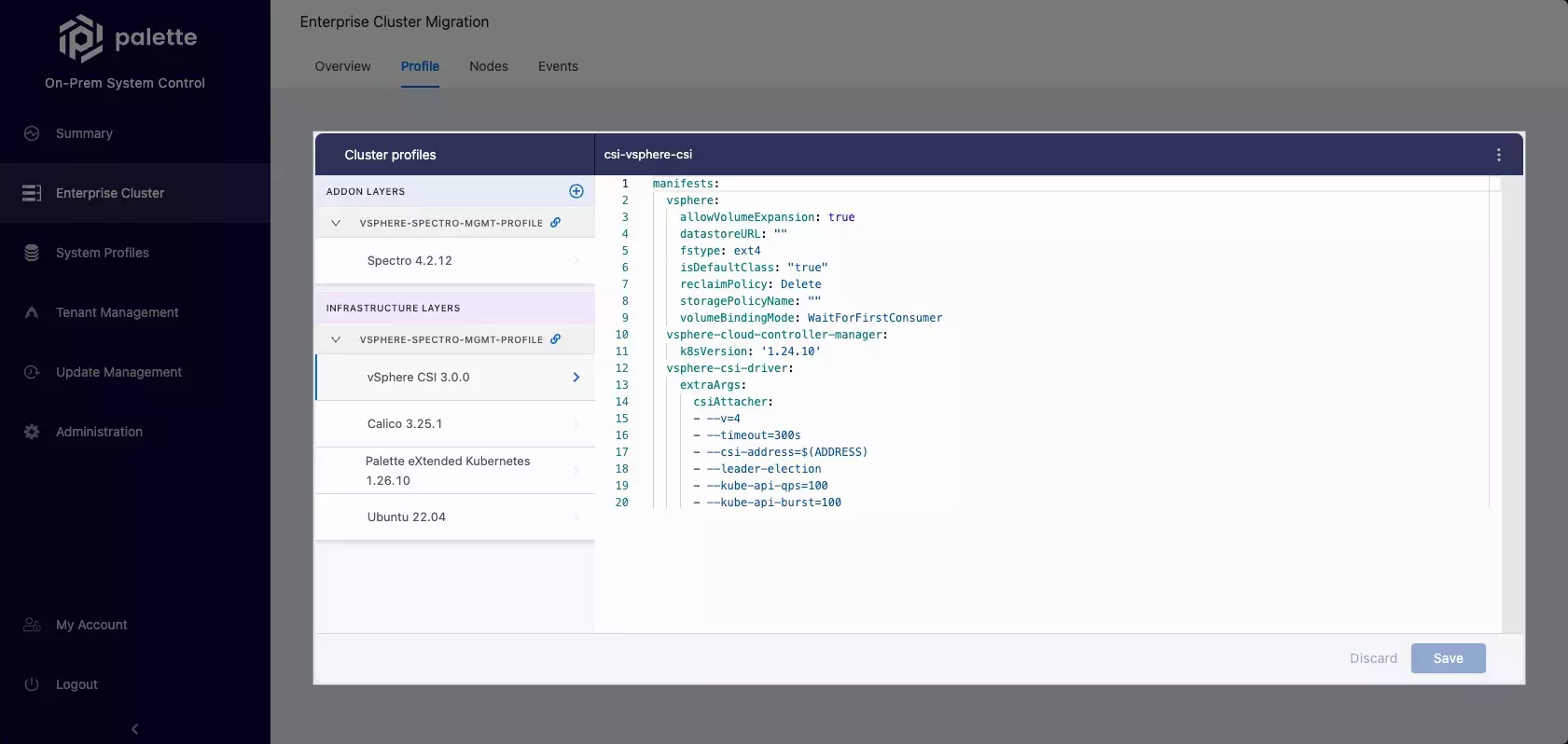
From the left Main Menu, select Enterprise Cluster and then select the Profile tab.
-
Copy the configurations for your CSI, CNI, and Kubernetes layers to an external location for backup.
tipIf your Enterprise Cluster profile has configuration changes or additions, make sure to back up all the customized values to preserve them after the upgrade.
-
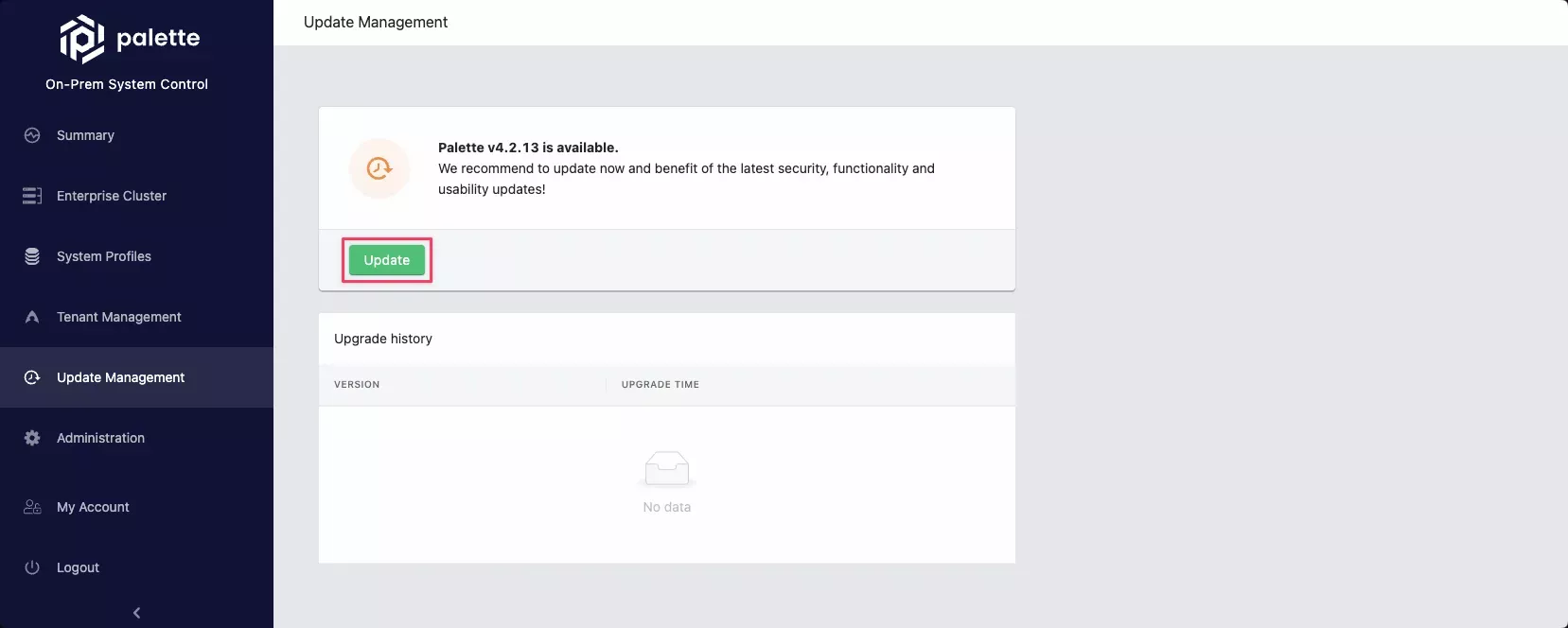
From the left Main Menu, select Update Management and click Update.
-
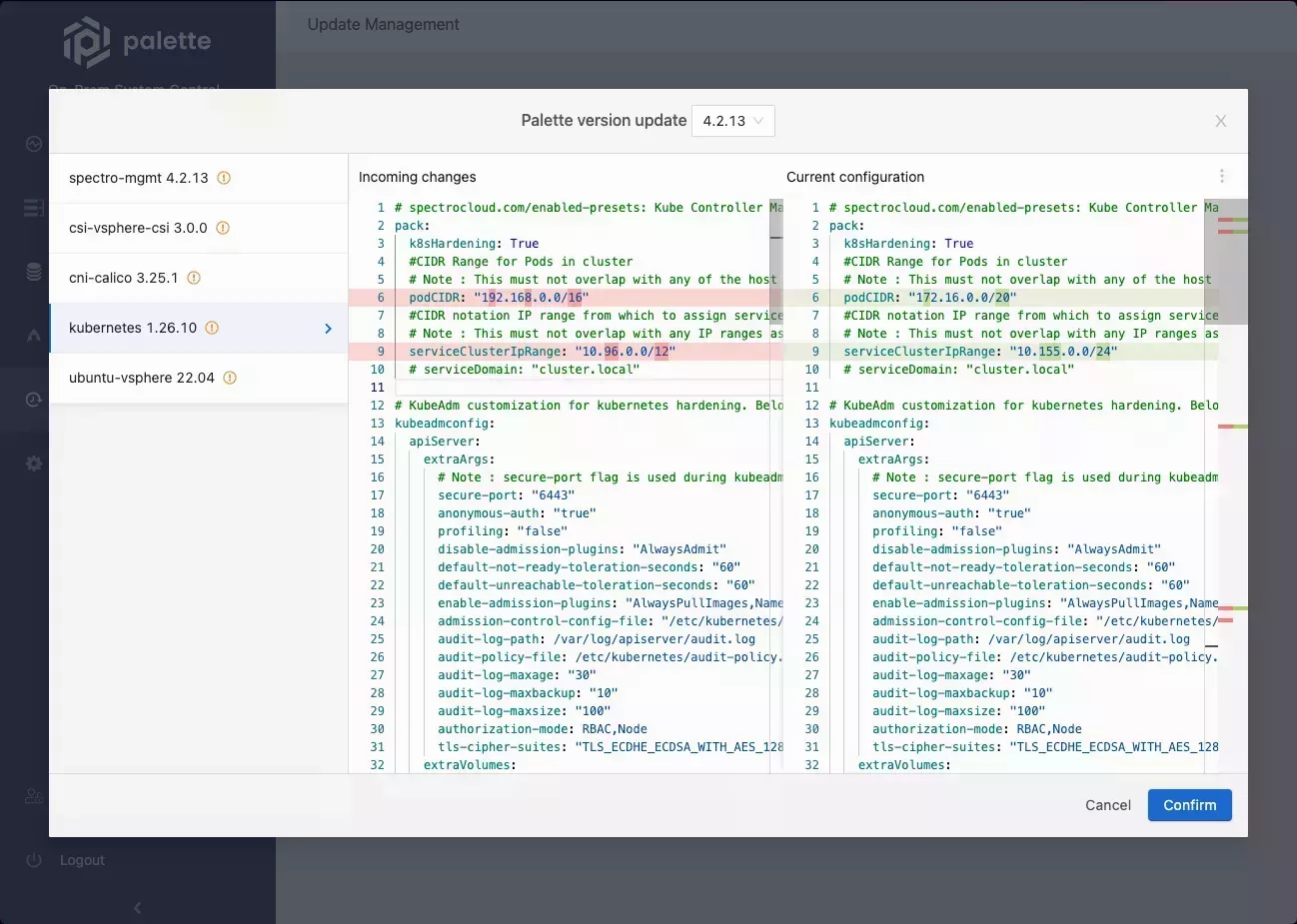
In the Palette version update preview modal, from the left menu, select the Kubernetes layer. The Incoming changes pane displays the changes that the upgrade introduces. The Current configuration pane displays your current layer configuration.
infoTo complete the Palette upgrade, we recommend using an external diff or text comparison tool. Proceed with the following steps once you have the comparison tool available next to the Palette system console.
-
Copy the configurations from both Incoming changes and Current configuration panes to your comparison tool.
-
From your current configuration, transfer only those differences that are custom to your self-hosted Palette instance (for example, the
podCIDRandserviceClusterIpRangevalues). Do not override any other changes or upgrades.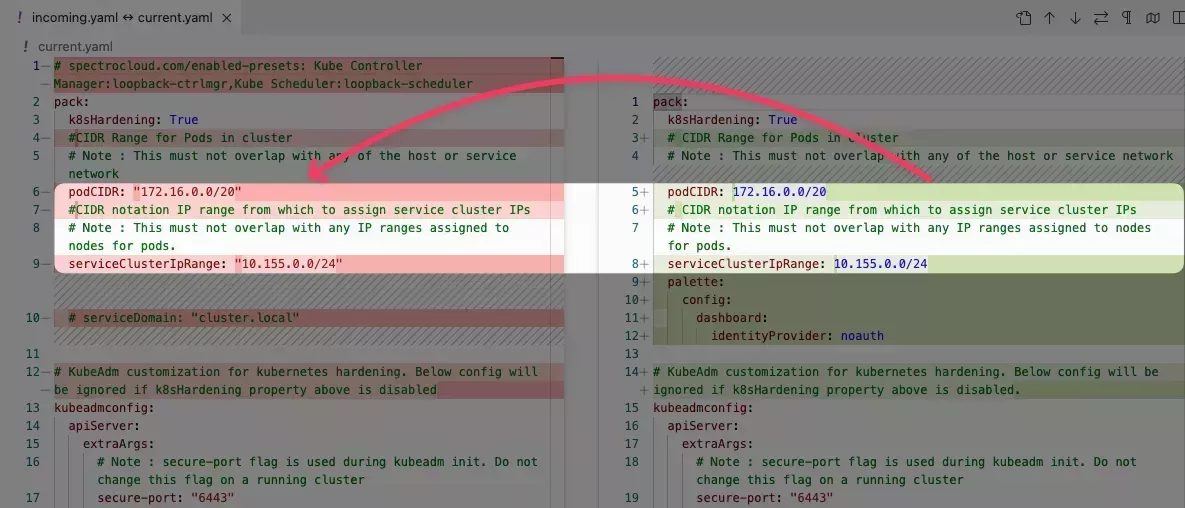
-
After you finish merging the configurations, copy the resulting configuration, and then paste it to the Current configuration pane in the Palette system console.
-
Repeat steps six through eight for each Enterprise Cluster profile layer.
-
In the bottom-right corner of the Palette version update preview modal, select Confirm.
The system console locks for a couple of minutes while the upgrade is applied.
Validate
-
Log in to the Palette system console.
-
On the Summary page, Palette should display messages that state You are using the latest version of Palette and On-prem system console is healthy.