OpenStack
The following are some highlights of OpenStack clusters provisioned by Palette:
-
Palette enables the ability to use OpenStack as an application platform for engineering team.
-
To facilitate communication between Palette and the OpenStack controllers installed in the private data center, a Private Cloud Gateway (PCG) must be set up within the environment.
-
Private Cloud Gateway (PCG) is Palette's self-hosted component to support isolated private cloud or data center environments. Once installed, the PCG registers itself with Palette and enables secure communication between the SaaS portal and the private cloud environment. The PCG enables installation and end-to-end lifecycle management of Kubernetes clusters in private cloud environments from Palette.
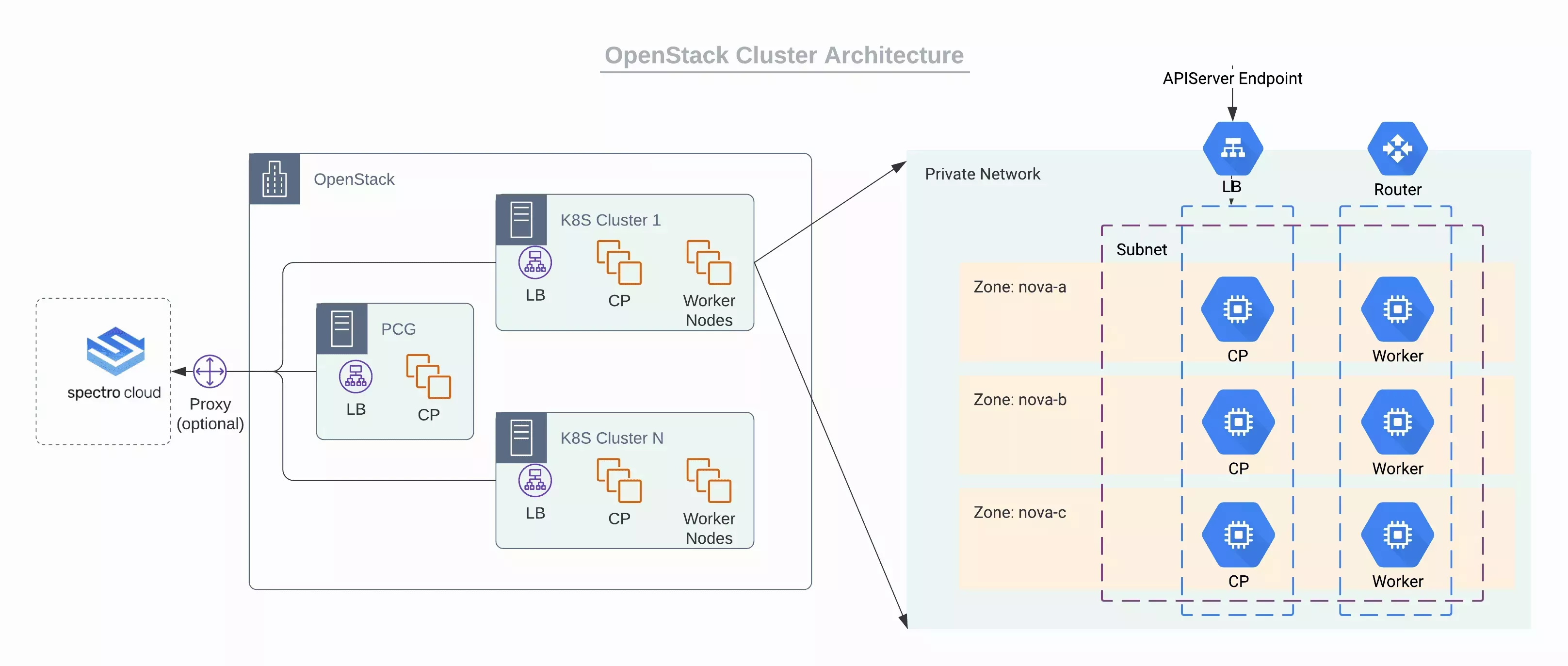
Refer to the PCG Architecture section to learn more about the PCG architecture.
OpenStack Cloud Account Permissions
- Cinder Service
- Neutron Service
- Glance Service
- Nova Compute Service
Cinder Service
Last Update: June 28, 2021
"volume:attachment_update": "rule:admin_or_owner"
"volume:attachment_delete": "rule:admin_or_owner"
"volume:attachment_complete": "rule:admin_or_owner"
"volume:multiattach_bootable_volume": "rule:admin_or_owner"
"message:get_all": "rule:admin_or_owner"
"message:get": "rule:admin_or_owner"
"message:delete": "rule:admin_or_owner"
"volume:get_snapshot_metadata": "rule:admin_or_owner"
"volume:update_snapshot_metadata": "rule:admin_or_owner"
"volume:delete_snapshot_metadata": "rule:admin_or_owner"
"volume:get_all_snapshots": "rule:admin_or_owner"
"volume_extension:extended_snapshot_attributes": "rule:admin_or_owner"
"volume:create_snapshot": "rule:admin_or_owner"
"volume:get_snapshot": "rule:admin_or_owner"
"volume:update_snapshot": "rule:admin_or_owner"
"volume:delete_snapshot": "rule:admin_or_owner"
"backup:get_all": "rule:admin_or_owner"
"backup:get": "rule:admin_or_owner"
"backup:update": "rule:admin_or_owner"
"backup:delete": "rule:admin_or_owner"
"backup:restore": "rule:admin_or_owner"
"group:get_all": "rule:admin_or_owner"
"group:get": "rule:admin_or_owner"
"group:update": "rule:admin_or_owner"
"group:get_all_group_snapshots": "rule:admin_or_owner"
"group:get_group_snapshot": "rule:admin_or_owner"
"group:delete_group_snapshot": "rule:admin_or_owner"
"group:update_group_snapshot": "rule:admin_or_owner"
"group:reset_group_snapshot_status": "rule:admin_or_owner"
"group:delete": "rule:admin_or_owner"
"group:enable_replication": "rule:admin_or_owner"
"group:disable_replication": "rule:admin_or_owner"
"group:failover_replication": "rule:admin_or_owner"
"group:list_replication_targets": "rule:admin_or_owner"
"volume_extension:quotas:show": "rule:admin_or_owner"
"limits_extension:used_limits": "rule:admin_or_owner"
"volume_extension:volume_type_access": "rule:admin_or_owner"
"volume:extend": "rule:admin_or_owner"
"volume:extend_attached_volume": "rule:admin_or_owner"
"volume:revert_to_snapshot": "rule:admin_or_owner"
"volume:retype": "rule:admin_or_owner"
"volume:update_readonly_flag": "rule:admin_or_owner"
"volume_extension:volume_actions:upload_image": "rule:admin_or_owner"
"volume_extension:volume_actions:initialize_connection": "rule:admin_or_owner"
"volume_extension:volume_actions:terminate_connection": "rule:admin_or_owner"
"volume_extension:volume_actions:roll_detaching": "rule:admin_or_owner"
"volume_extension:volume_actions:reserve": "rule:admin_or_owner"
"volume_extension:volume_actions:unreserve": "rule:admin_or_owner"
"volume_extension:volume_actions:begin_detaching": "rule:admin_or_owner"
"volume_extension:volume_actions:attach": "rule:admin_or_owner"
"volume_extension:volume_actions:detach": "rule:admin_or_owner"
"volume:get_all_transfers": "rule:admin_or_owner"
"volume:create_transfer": "rule:admin_or_owner"
"volume:get_transfer": "rule:admin_or_owner"
"volume:delete_transfer": "rule:admin_or_owner"
"volume:get_volume_metadata": "rule:admin_or_owner"
"volume:create_volume_metadata": "rule:admin_or_owner"
"volume:update_volume_metadata": "rule:admin_or_owner"
"volume:delete_volume_metadata": "rule:admin_or_owner"
"volume_extension:volume_image_metadata": "rule:admin_or_owner"
"volume:get": "rule:admin_or_owner"
"volume:get_all": "rule:admin_or_owner"
"volume:update": "rule:admin_or_owner"
"volume:delete": "rule:admin_or_owner"
"volume_extension:volume_tenant_attribute": "rule:admin_or_owner"
"volume_extension:volume_encryption_metadata": "rule:admin_or_owner"
"volume:multiattach": "rule:admin_or_owner"
Neutron Service
Last Update: June 28, 2021
    "create_subnet": "rule:admin_or_network_owner",
    "get_subnet": "rule:admin_or_owner or rule:shared",
    "update_subnet": "rule:admin_or_network_owner",
    "delete_subnet": "rule:admin_or_network_owner",
    "get_subnetpool": "rule:admin_or_owner or rule:shared_subnetpools",
    "update_subnetpool": "rule:admin_or_owner",
    "delete_subnetpool": "rule:admin_or_owner",
    "get_address_scope": "rule:admin_or_owner or rule:shared_address_scopes",
    "update_address_scope": "rule:admin_or_owner",
    "delete_address_scope": "rule:admin_or_owner",
    "get_network": "rule:admin_or_owner or rule:shared or rule:external or rule:context_is_advsvc",
    "update_network": "rule:admin_or_owner",
    "delete_network": "rule:admin_or_owner",
    "network_device": "field:port:device_owner=~^network:",
    "create_port:device_owner": "not rule:network_device or rule:context_is_advsvc or rule:admin_or_network_owner",
    "create_port:mac_address": "rule:context_is_advsvc or rule:admin_or_network_owner",
    "create_port:fixed_ips": "rule:context_is_advsvc or rule:admin_or_network_owner or rule:shared",
    "create_port:fixed_ips:ip_address": "rule:context_is_advsvc or rule:admin_or_network_owner",
    "create_port:fixed_ips:subnet_id": "rule:context_is_advsvc or rule:admin_or_network_owner or rule:shared",
    "create_port:port_security_enabled": "rule:context_is_advsvc or rule:admin_or_network_owner",
    "create_port:mac_learning_enabled": "rule:context_is_advsvc or rule:admin_or_network_owner",
    "create_port:allowed_address_pairs": "rule:admin_or_network_owner",
    "create_port:allowed_address_pairs:mac_address": "rule:admin_or_network_owner",
    "create_port:allowed_address_pairs:ip_address": "rule:admin_or_network_owner",
    "get_port": "rule:context_is_advsvc or rule:admin_owner_or_network_owner",
    "update_port": "rule:admin_or_owner or rule:context_is_advsvc",
    "update_port:device_owner": "not rule:network_device or rule:context_is_advsvc or rule:admin_or_network_owner",
    "update_port:fixed_ips": "rule:context_is_advsvc or rule:admin_or_network_owner or rule:shared",
    "update_port:fixed_ips:ip_address": "rule:context_is_advsvc or rule:admin_or_network_owner",
    "update_port:fixed_ips:subnet_id": "rule:context_is_advsvc or rule:admin_or_network_owner or rule:shared",
    "update_port:port_security_enabled": "rule:context_is_advsvc or rule:admin_or_network_owner",
    "update_port:mac_learning_enabled": "rule:context_is_advsvc or rule:admin_or_network_owner",
    "update_port:allowed_address_pairs": "rule:admin_or_network_owner",
    "update_port:allowed_address_pairs:mac_address": "rule:admin_or_network_owner",
    "update_port:allowed_address_pairs:ip_address": "rule:admin_or_network_owner",
    "delete_port": "rule:context_is_advsvc or rule:admin_owner_or_network_owner",
    "create_router:external_gateway_info": "rule:admin_or_owner",
    "create_router:external_gateway_info:network_id": "rule:admin_or_owner",
    "get_router": "rule:admin_or_owner",
    "update_router": "rule:admin_or_owner",
    "update_router:external_gateway_info": "rule:admin_or_owner",
    "update_router:external_gateway_info:network_id": "rule:admin_or_owner",
    "delete_router": "rule:admin_or_owner",
    "add_router_interface": "rule:admin_or_owner",
    "remove_router_interface": "rule:admin_or_owner",
    "update_floatingip": "rule:admin_or_owner",
    "delete_floatingip": "rule:admin_or_owner",
    "get_floatingip": "rule:admin_or_owner",
    "update_rbac_policy": "rule:admin_or_owner",
    "update_rbac_policy:target_tenant": "rule:restrict_wildcard and rule:admin_or_owner",
    "get_rbac_policy": "rule:admin_or_owner",
    "delete_rbac_policy": "rule:admin_or_owner",
    "get_auto_allocated_topology": "rule:admin_or_owner",
    "get_trunk": "rule:admin_or_owner",
    "delete_trunk": "rule:admin_or_owner",
    "add_subports": "rule:admin_or_owner",
    "remove_subports": "rule:admin_or_owner",
    "get_security_groups": "rule:admin_or_owner",
    "get_security_group": "rule:admin_or_owner",
    "create_security_group": "rule:admin_or_owner",
    "update_security_group": "rule:admin_or_owner",
    "delete_security_group": "rule:admin_or_owner",
    "get_security_group_rules": "rule:admin_or_owner",
    "get_security_group_rule": "rule:admin_owner_or_sg_owner",
    "create_security_group_rule": "rule:admin_or_owner",
    "delete_security_group_rule": "rule:admin_or_owner",
Glance Service
Last Update: June 28, 2021
    "add_image": "role:admin or role:member",
    "delete_image": "role:admin or role:member",
    "get_image": "role:admin or role:member",
    "get_images": "role:admin or role:member",
    "publicize_image": "role:admin or role:member",
    "download_image": "role:admin or role:member",
    "upload_image": "role:admin or role:member",
    "get_image_location": "role:admin or role:member",
    "set_image_location": "role:admin or role:member",
Nova Compute Service
Last Update: June 28, 2021
 "os_compute_api:os-admin-password": "rule:admin_or_owner",
    "os_compute_api:os-attach-interfaces": "rule:admin_or_owner",
    "os_compute_api:os-attach-interfaces:create": "rule:admin_or_owner",
    "os_compute_api:os-attach-interfaces:delete": "rule:admin_or_owner",
    "os_compute_api:os-availability-zone:list": "rule:admin_or_owner",
    "os_compute_api:os-config-drive": "rule:admin_or_owner",
    "os_compute_api:os-console-output": "rule:admin_or_owner",
    "os_compute_api:os-consoles:create": "rule:admin_or_owner",
    "os_compute_api:os-consoles:show": "rule:admin_or_owner",
    "os_compute_api:os-consoles:delete": "rule:admin_or_owner",
    "os_compute_api:os-consoles:index": "rule:admin_or_owner",
    "os_compute_api:os-create-backup": "rule:admin_or_owner",
    "os_compute_api:os-deferred-delete": "rule:admin_or_owner",
    "os_compute_api:os-extended-availability-zone": "rule:admin_or_owner",
    "os_compute_api:os-extended-status": "rule:admin_or_owner",
    "os_compute_api:os-extended-volumes": "rule:admin_or_owner",
    "os_compute_api:extensions": "rule:admin_or_owner",
    "os_compute_api:os-flavor-access": "rule:admin_or_owner",
    "os_compute_api:os-flavor-extra-specs:show": "rule:admin_or_owner",
    "os_compute_api:os-flavor-extra-specs:index": "rule:admin_or_owner",
    "os_compute_api:os-flavor-rxtx": "rule:admin_or_owner",
    "os_compute_api:flavors": "rule:admin_or_owner",
    "os_compute_api:os-floating-ip-dns": "rule:admin_or_owner",
    "os_compute_api:os-floating-ip-pools": "rule:admin_or_owner",
    "os_compute_api:os-floating-ips": "rule:admin_or_owner",
    "os_compute_api:os-fping": "rule:admin_or_owner",
    "os_compute_api:image-size": "rule:admin_or_owner",
    "os_compute_api:os-instance-actions": "rule:admin_or_owner",
    "os_compute_api:ips:show": "rule:admin_or_owner",
    "os_compute_api:ips:index": "rule:admin_or_owner",
    "os_compute_api:os-keypairs": "rule:admin_or_owner",
    "os_compute_api:limits": "rule:admin_or_owner",
    "os_compute_api:os-lock-server:lock": "rule:admin_or_owner",
    "os_compute_api:os-lock-server:unlock": "rule:admin_or_owner",
    "os_compute_api:os-multinic": "rule:admin_or_owner",
    "os_compute_api:os-networks:view": "rule:admin_or_owner",
    "os_compute_api:os-pause-server:pause": "rule:admin_or_owner",
    "os_compute_api:os-pause-server:unpause": "rule:admin_or_owner",
    "os_compute_api:os-quota-sets:show": "rule:admin_or_owner",
    "os_compute_api:os-quota-sets:detail": "rule:admin_or_owner",
    "os_compute_api:os-remote-consoles": "rule:admin_or_owner",
    "os_compute_api:os-rescue": "rule:admin_or_owner",
    "os_compute_api:os-security-groups": "rule:admin_or_owner",
    "os_compute_api:os-server-groups": "rule:admin_or_owner",
    "os_compute_api:server-metadata:index": "rule:admin_or_owner",
    "os_compute_api:server-metadata:show": "rule:admin_or_owner",
    "os_compute_api:server-metadata:create": "rule:admin_or_owner",
    "os_compute_api:server-metadata:update_all": "rule:admin_or_owner",
    "os_compute_api:server-metadata:update": "rule:admin_or_owner",
    "os_compute_api:server-metadata:delete": "rule:admin_or_owner",
    "os_compute_api:os-server-password": "rule:admin_or_owner",
    "os_compute_api:os-server-tags:delete_all": "rule:admin_or_owner",
    "os_compute_api:os-server-tags:index": "rule:admin_or_owner",
    "os_compute_api:os-server-tags:update_all": "rule:admin_or_owner",
    "os_compute_api:os-server-tags:delete": "rule:admin_or_owner",
    "os_compute_api:os-server-tags:update": "rule:admin_or_owner",
    "os_compute_api:os-server-tags:show": "rule:admin_or_owner",
    "os_compute_api:os-server-usage": "rule:admin_or_owner",
    "os_compute_api:servers:index": "rule:admin_or_owner",
    "os_compute_api:servers:detail": "rule:admin_or_owner",
    "os_compute_api:servers:show": "rule:admin_or_owner",
    "os_compute_api:servers:create": "rule:admin_or_owner",
    "os_compute_api:servers:create:attach_volume": "rule:admin_or_owner",
    "os_compute_api:servers:create:attach_network": "rule:admin_or_owner",
    "os_compute_api:servers:delete": "rule:admin_or_owner",
    "os_compute_api:servers:update": "rule:admin_or_owner",
    "os_compute_api:servers:confirm_resize": "rule:admin_or_owner",
    "os_compute_api:servers:revert_resize": "rule:admin_or_owner",
    "os_compute_api:servers:reboot": "rule:admin_or_owner",
    "os_compute_api:servers:resize": "rule:admin_or_owner",
    "os_compute_api:servers:rebuild": "rule:admin_or_owner",
    "os_compute_api:servers:create_image": "rule:admin_or_owner",
    "os_compute_api:servers:create_image:allow_volume_backed": "rule:admin_or_owner",
    "os_compute_api:servers:start": "rule:admin_or_owner",
    "os_compute_api:servers:stop": "rule:admin_or_owner",
    "os_compute_api:servers:trigger_crash_dump": "rule:admin_or_owner",
    "os_compute_api:os-shelve:shelve": "rule:admin_or_owner",
    "os_compute_api:os-shelve:unshelve": "rule:admin_or_owner",
    "os_compute_api:os-simple-tenant-usage:show": "rule:admin_or_owner",
    "os_compute_api:os-suspend-server:resume": "rule:admin_or_owner",
    "os_compute_api:os-suspend-server:suspend": "rule:admin_or_owner",
    "os_compute_api:os-tenant-networks": "rule:admin_or_owner",
    "os_compute_api:os-virtual-interfaces": "rule:admin_or_owner",
    "os_compute_api:os-volumes": "rule:admin_or_owner",
    "os_compute_api:os-volumes-attachments:index": "rule:admin_or_owner",
    "os_compute_api:os-volumes-attachments:create": "rule:admin_or_owner",
    "os_compute_api:os-volumes-attachments:show": "rule:admin_or_owner",
    "os_compute_api:os-volumes-attachments:delete": "rule:admin_or_owner"
Create an OpenStack Cloud Account
A default cloud account is automatically created when the private cloud gateway is configured. This cloud account can be used to create tenant clusters. Additional cloud accounts may be created if desired within the same gateway.
Prerequisites
- A PCG is installed and available in the OpenStack. Refer to the Deploy to OpenStack guide to learn how to deploy a PCG.
Create Cloud Account
-
To create an OpenStack cloud account, proceed to project settings and select 'create cloud account' under OpenStack.
-
Fill the following values to the cloud account creation wizard.
Property Description Account Name Custom name for the cloud account Private cloud gateway Reference to a running cloud gateway Username OpenStack Username Password OpenStack Password Identity Endpoint Identity Endpoint of the gateway CA Certificate Digital certificate of authority Parent Region OpenStack Region to be used Default Domain Default OpenStack domain Default Project Default OpenStack project
Deploy an OpenStack Cluster
Prerequisites
- A PCG is installed and available in the OpenStack. Refer to the Deploy to OpenStack guide to learn how to deploy a PCG.
OpenStack support is limited to the Kubernetes distribution Palette eXtended Kubernetes (PXK) for version 1.24.x.
Deploy Cluster
The following steps need to be performed to provision a new OpenStack cluster:
-
Provide basic cluster information like Name, Description, and Tags. Tags are currently not propagated to the VMs deployed on the cloud/data center environments.
-
Choose between deploying your cluster using individual cluster profiles or a single cluster template.
- Cluster Profiles
- Cluster Templates
-
On the Cluster setup type window, choose Cluster Profiles > Add Cluster Profile.
-
Select the appropriate full or infrastructure cluster profile and Confirm your selection.
-
Review the layers of your cluster profile. Use the drop-down menus to select the appropriate cluster profile version, add necessary add-on profiles, and make changes to YAML configuration files as needed. When finished, select Next.
info- Cluster profile versions linked to cluster templates cannot be used in the cluster profile workflow.
- For ease of reuse and to persist changes across clusters using the same cluster profile, we recommend creating a new version of your cluster profile rather than making inline changes.
-
On the Cluster setup type window, choose Cluster Template > Select Cluster Template.
-
Select the appropriate cluster template and Confirm your selection.
-
Expand the Maintenance policy and Linked profiles panels to review the configuration of your cluster template.
If you need to make any changes, such as swapping your maintenance policy or updating your cluster profile version, you must exit the cluster deployment workflow and modify your cluster template before proceeding. If no changes are needed, select Next.
-
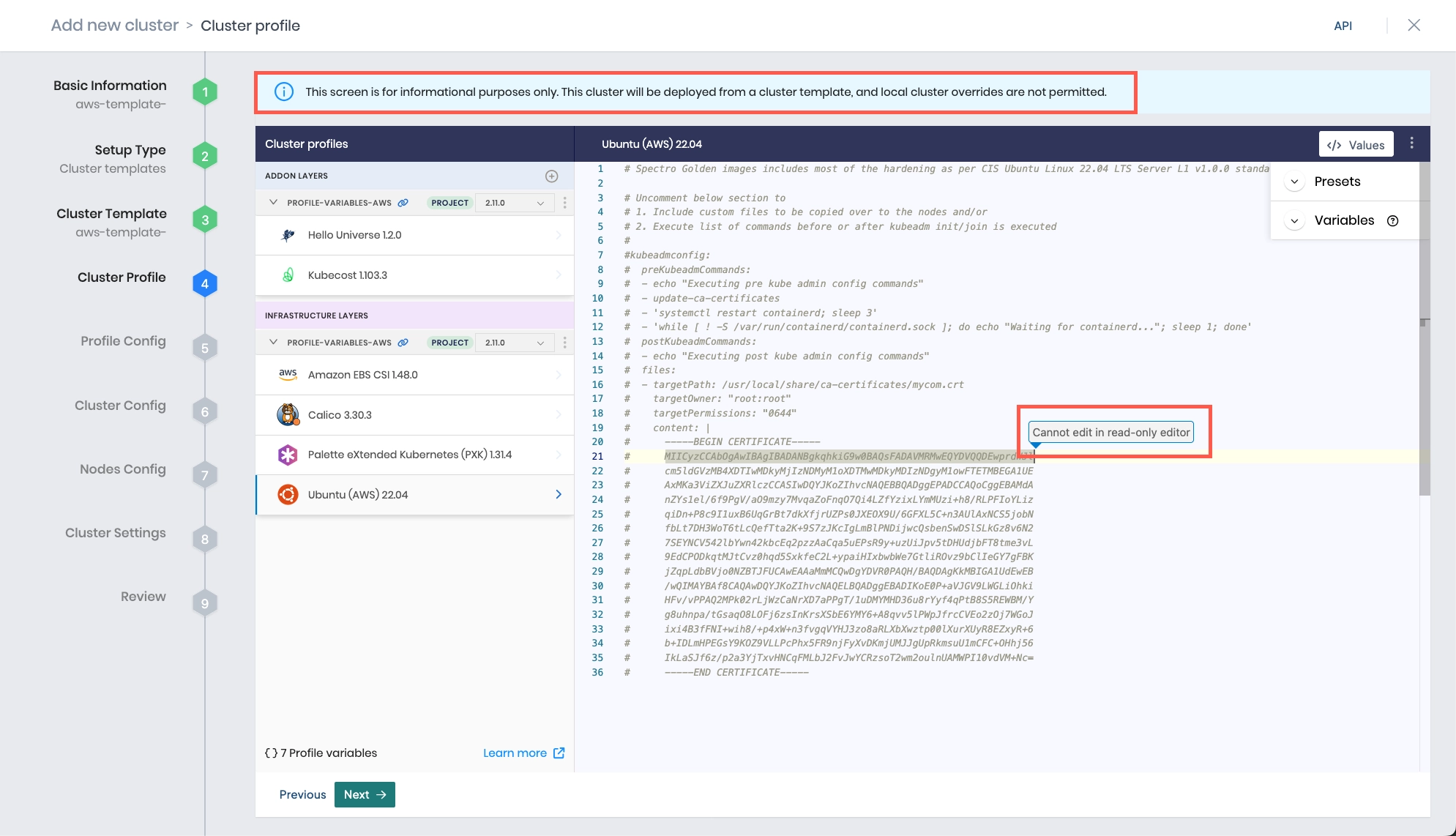
Review the layers of your cluster profile. If no changes are needed, select Next.
warningCluster profile changes, such as modifying your cluster profile version, adding additional add-on profiles, and editing YAML configuration files, are not allowed when deploying a cluster. Once a cluster profile is linked to a cluster template, that version of the cluster profile is locked to prevent configuration drift across clusters. If you need to make changes, you must create a new version of your cluster profile and modify your cluster template to use the new version.
-
The Profile variables configuration window opens if your cluster profile is configured to use cluster profile variables. Fill in the appropriate values, and select Next.
-
Provide an OpenStack Cloud account and placement information.
- Cloud Account - Select the desired cloud account. OpenStack cloud accounts with credentials need to be
preconfigured in project settings. An account is auto-created as part of the cloud gateway setup and is available
for provisioning of tenant clusters if permitted by the administrator.
- Domain
- Region
- Project
- SSH Key
- Placement
- If the user choice of placement is Static then:
- Network
- Subnet
- If the user choice of placement is NOT Static then:
- Subnet CIDR
- DNS Name Server
- If the user choice of placement is Static then:
- Cloud Account - Select the desired cloud account. OpenStack cloud accounts with credentials need to be
preconfigured in project settings. An account is auto-created as part of the cloud gateway setup and is available
for provisioning of tenant clusters if permitted by the administrator.
-
Configure the control plane and worker node pools. Fill out the input fields in the Add node pool page. The following table contains an explanation of the available input parameters.
Control Plane Pool
Parameter Description Name A descriptive name for the node pool. Size Number of VMs to be provisioned for the node pool. For the control plane pool, this number can be 1, 3, or 5. Allow worker capability Select this option for allowing workloads to be provisioned on control plane nodes. Labels Add a label to apply placement constraints on a pod, such as a node eligible for receiving the workload. Taints To set toleration to pods and allow (but do not require) the pods to schedule onto nodes with matching taints. Instance type Select the compute instance type to be used for all nodes in the node pool. Availability Zones Choose one or more availability zones. Palette provides fault tolerance to guard against hardware failures, network failures, etc., by provisioning nodes across availability zones if multiple zones are selected. Disk Size Give the required storage size Worker Pool
Parameter Description Name A descriptive name for the node pool. Enable Autoscaler Scale the pool horizontally based on its per-node workload counts. The Minimum size specifies the lower bound of nodes in the pool, and the Maximum size specifies the upper bound. Setting both parameters to the same value results in a static node count. Refer to the Cluster API autoscaler documentation for more information on autoscaling. Size Number of VMs to be provisioned for the node pool. This field is hidden if Enable Autoscaler is toggled on. Rolling Update Rolling update has two available options. The expand option launches a new node first, then shuts down old one. The contract option shuts down a old one first, then launches new one. Labels Add a label to apply placement constraints on a pod, such as a node eligible for receiving the workload. Taints To set toleration to pods and allow (but do not require) the pods to schedule onto nodes with matching taints. Instance type Select the compute instance type to be used for all nodes in the node pool. Availability Zones Choose one or more availability zones. Palette provides fault tolerance to guard against hardware failures, network failures, etc., by provisioning nodes across availability zones if multiple zones are selected. Disk Size Provide the required storage size -
On the Cluster Settings page, configure additional options as needed. If you are deploying your cluster using cluster templates, a Cluster Timezone is required.
Left Menu Item Additional Information Cluster Timezone Specify the time zone where your cluster is being deployed. The time zone is used in maintenance policies to determine when updates are rolled out to clusters deployed with cluster templates. Manage machines Set an OS patching schedule and specify node behavior when creating your cluster, including upgrading your nodes to use the latest OS patch version and allowing reboots. Schedule scans Enable any scan options you want Palette to perform and select a scan schedule. Palette supports Kubernetes configuration security, penetration testing, and conformance testing. Refer to Compliance Scan for details on each scan type. Schedule backups Schedule backups for your entire cluster or etcd. Refer to Backup and Restore for more information. RBAC Map a set of users or groups to a Kubernetes RBAC role. This is required when custom OIDC is configured. Refer to the following guides for more information:
- Create Role Bindings
- Palette eXtended Kubernetes (PXK) -
Select Validate to review your cluster configurations and settings.
-
If no changes are needed, select Finish Configuration to deploy your cluster.
To monitor the status of your cluster deployment, from the left main menu, select Clusters and choose your cluster. The cluster Overview tab displays the status and health of your cluster, as well as deployment details. Use the Events tab to monitor the deployment in real time. Provisioning may take several minutes.
Deleting an OpenStack Cluster
The deletion of an OpenStack cluster results in the removal of all Virtual machines and associated storage disks created for the cluster. The following tasks need to be performed to delete an OpenStack cluster:
-
Select the cluster to be deleted from the Cluster View page and navigate to the Cluster Overview page.
-
Invoke a delete action available on the page: Cluster > Settings > Cluster Settings > Delete Cluster.
-
Click Confirm to delete.
The Cluster Status is updated to Deleting while cluster resources are being deleted. Provisioning status is updated with the ongoing progress of the delete operation. Once all resources are successfully deleted, the cluster status changes to Deleted and is removed from the list of clusters.
Delete action is only available for clusters that are fully provisioned. For clusters that are still in the process of being provisioned, the 'Abort' action is available to stop provisioning and delete all resources.
Force Delete a Cluster
A cluster stuck in the Deletion state can be force deleted by the user through the User Interface. The user can go for a force deletion of the cluster, only if it is stuck in a deletion state for a minimum of 15 minutes. Palette enables cluster force delete from the Tenant Admin and Project Admin scope.
-
Log in to the Palette Management Console.
-
Navigate to the Cluster Details page of the cluster stuck in deletion.
-
If the deletion is stuck for more than 15 minutes, click the Force Delete Cluster button from the Settings dropdown.
-
If the Force Delete Cluster button is not enabled, wait for 15 minutes. The Settings dropdown will give the estimated time for the auto-enabling of the Force Delete button.
-
If there are any cloud resources still on the cloud, the user should cleanup those resources before going for the force deletion.