Create OpenShift Workload Cluster with HyperShift Control Plane
OpenShift workload clusters use a hosted control plane model where their Kubernetes control plane components run as pods in the HyperShift host cluster. Worker nodes are then provisioned as bare-metal MAAS hosts.
Limitations
-
It is not possible to install additional add-on layers on OpenShift workload clusters through Palette. If you need to install add-ons such as MetalLB and Piraeus, we recommend using the OperatorHub. The OperatorHub is accessed through the OpenShift console of your workload cluster. Add-ons installed through the OperatorHub are managed directly through the OpenShift console and are not visible in Palette.
-
Only the Bring Your Own OS (BYOOS) pack is supported for the OS layer. The CoreOS image must be prepared specifically for MAAS using the process described in Prepare CoreOS image. Standard MAAS OS images are not compatible with OpenShift.
-
Open Virtual Networking (OVN)-Kubernetes is configured automatically by the OpenShift pack. A dedicated OVN-Kubernetes Container Network Interface (CNI) pack is not supported. The CNI layer of the workload cluster profile must use the OVN-Kubernetes CNI pack as a passthrough as mentioned in the prerequisites for creating OpenShift workload clusters.
-
Some Day 1 operations are not available through Palette, such as configuring an external OpenID Connect (OIDC) provider or Network Time Protocol (NTP) servers.
-
Some Day 2 operations are not available through Palette, such as OS patching, security and compliance scans, backup and restore, and maintenance mode.
Prerequisites
-
The MAAS-compatible CoreOS image imported in Prepare CoreOS image must be available in your MAAS environment.
-
The HyperShift host cluster created in Create HyperShift Host Cluster must be in the Running state with the HyperShift Operator healthy.
-
The Cluster Admin role in Palette.
-
- If you have not yet created a cluster profile for the HyperShift host cluster, you also need the Cluster Profile Admin role.
-
-
A cluster profile for your OpenShift workload clusters configured with the following packs:
-
Bring Your Own OS (BYOOS) pack for the OS layer. Set the following parameters in the pack values.
Parameter Description Example values pack.osImageOverrideThe name of the MAAS image imported when following the Prepare CoreOS image guide. This should match the <image-name>parameter specified during import.rhcos-4.20.13-with-ubuntu
scos-10.0pack.osNameThe value of the <operating-system>parameter specified during import.openshift
scospack.osVersionThe value of the <release-version>parameter specified during import.4.20.13
10.0.20250628-0 -
OpenShift pack for the Kubernetes layer. Ensure the OpenShift version is compatible with the HyperShift Operator version installed on the host cluster. Refer to the HyperShift Operator (HO) Versioning Support documentation for guidance.
-
Ensure to set the Red Hat OpenShift pull secret in the
cluster.pullSecretparameter of the OpenShift pack values. This is required for the OpenShift installer to pull necessary images from Red Hat's container registry. Obtain your pull secret from the Red Hat OpenShift Cluster Manager. The pull secret must be Base64-encoded.Example command to encode the pull secret in Base64
In this example, the pull secret is stored in a file named
pull-secret.txt. The command reads the pull secret from the file, encodes it in Base64 format, and sets it as theOPENSHIFT_PULL_SECRETenvironment variable. The--wrap 0option forbase64ensures that the output is a single line, which is necessary for proper formatting in the OpenShift pack values.Base64 encode pull secretexport OPENSHIFT_PULL_SECRET=$(cat pull-secret.txt | base64 --wrap 0)
echo $OPENSHIFT_PULL_SECRET -
We recommend to add the
cluster.controlPlaneHighAvailabilityparameter to the OpenShift pack values and set it totrue. This parameter is not present by default and must be added manually.Example OpenShift pack values with control plane HA enabledpack:
...
cluster:
controlPlaneHighAvailability: true
...- When
cluster.controlPlaneHighAvailabilityistrue, the hosted control plane runs in HA mode with multiple replicas of API server, etcd, and other components. This allows PodDisruptionBudgets (PDBs) to maintain availability during node repave, and drain operations can proceed without issues. - When
cluster.controlPlaneHighAvailabilityisfalseor not set, the hosted control plane runs with a single replica (non-HA). In this configuration, a node repave or any other operation that drains the node hosting that control plane replica can remain blocked because the PDB prevents eviction of the control plane pod. The typical symptom is that the repaving node remains in theDeletingorDrainingstate until the drain completes.
- When
-
-
OVN-Kubernetes CNI pack for the Network layer. This is used as a passthrough CNI pack since the CNI is configured automatically by the OpenShift pack and a dedicated CNI pack is not supported for OpenShift workload clusters hosted on HyperShift.
-
The Local Path Provisioner pack is the only validated pack for the Storage layer. As mentioned in the Limitations section, if you wish to use a different Container Storage Interface (CSI), you can install it through the OperatorHub in the OpenShift console after cluster deployment.
-
Enablement
-
Log in to Palette.
-
Ensure you are in the correct project scope.
-
From the left main menu, select Clusters and click Add New Cluster.
-
In the Data Center section, select MAAS, then click Start MAAS Configuration.
-
Enter the basic information for your cluster, including the Cluster Name, Description, and Tags.
From the Cloud Account drop-down menu, select your MAAS cloud account.
Click Next when done.
-
Choose between deploying your cluster using individual cluster profiles or a single cluster template.
- Cluster Profiles
- Cluster Templates
-
In the Cluster setup type window, choose Cluster Profiles > Add Cluster Profile.
-
Select the appropriate full or infrastructure cluster profile and Confirm your selection.
-
Review the layers of your cluster profile. Use the drop-down menus to select the appropriate cluster profile version, add necessary add-on profiles, and make changes to YAML configuration files as needed. When finished, select Next.
info- Cluster profile versions linked to cluster templates cannot be used in the cluster profile workflow.
- For ease of reuse and to persist changes across clusters using the same cluster profile, we recommend creating a new version of your cluster profile rather than making inline changes.
-
In the Cluster setup type window, choose Cluster Template > Select Cluster Template.
-
Select the appropriate cluster template and Confirm your selection.
-
Expand the Maintenance policy and Linked profiles panels to review the configuration of your cluster template.
If you need to make any changes, such as swapping your maintenance policy or updating your cluster profile version, you must exit the cluster deployment workflow and modify your cluster template before proceeding. If no changes are needed, select Next.
-
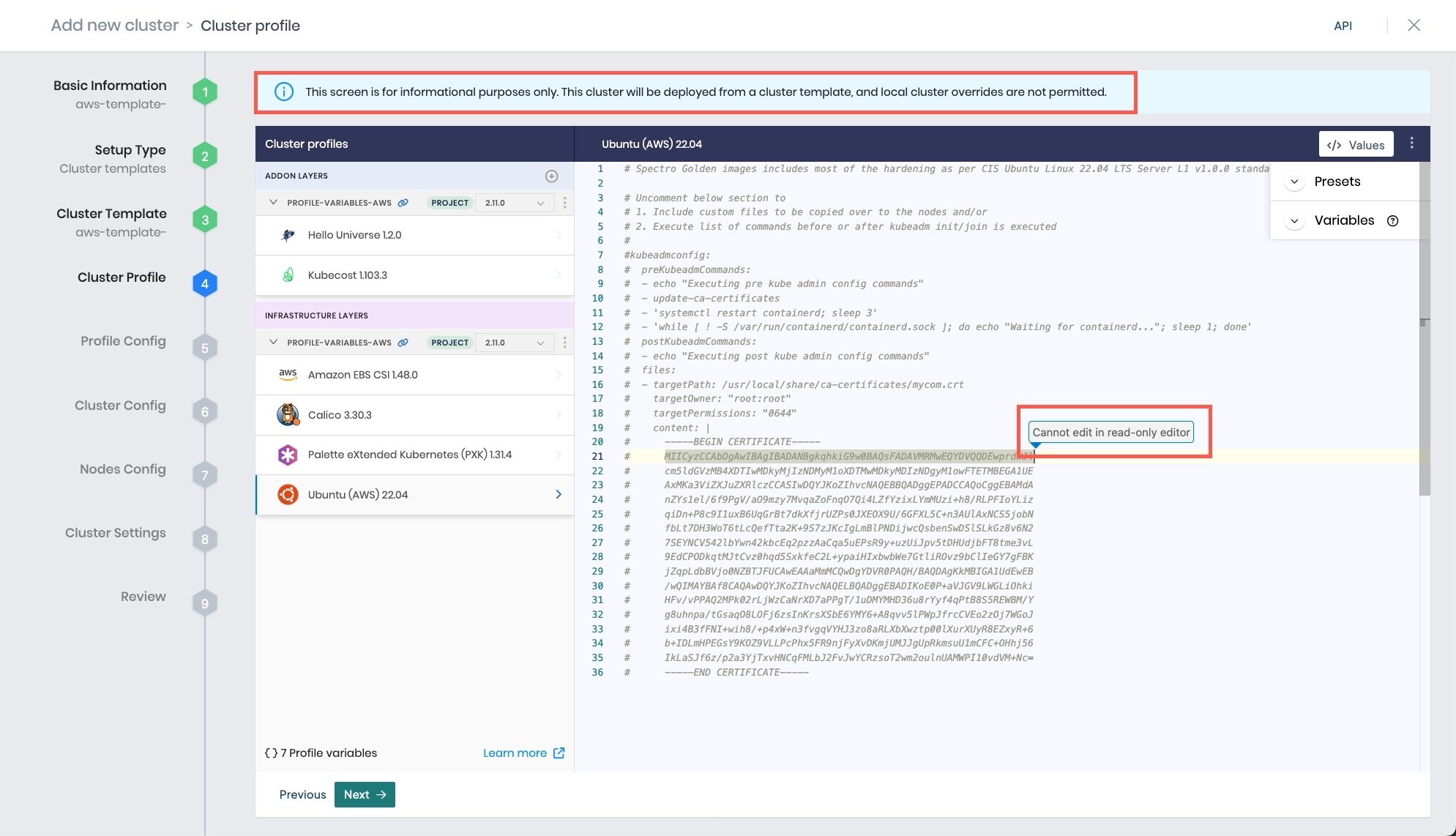
Review the layers of your cluster profile. If no changes are needed, select Next.
warningCluster profile changes, such as modifying your cluster profile version, adding additional add-on profiles, and editing YAML configuration files, are not allowed when deploying a cluster. Once a cluster profile is linked to a cluster template, that version of the cluster profile is locked to prevent configuration drift across clusters. If you need to make changes, you must create a new version of your cluster profile and modify your cluster template to use the new version.
-
The Profile variables configuration window opens if your cluster profile is configured to use cluster profile variables. Fill in the appropriate values, and select Next.
-
Fill out the following fields on the Cluster Config step. Click Next when done.
Field Description Domains Register a DNS record in the selected domain for the deployed cluster. The DNS record links to the IP addresses of the control plane nodes. SSH Keys (Optional) This field has no effect on OpenShift workload clusters. Palette does not inject SSH keys into RHCOS worker nodes; SSH access is governed by OpenShift and RHCOS mechanisms. Refer to SSH Access on OpenShift Workload Clusters for details. NTP Servers (Optional) This field has no effect on OpenShift workload clusters. Palette does not apply NTP servers to RHCOS worker nodes; time synchronization is governed by OpenShift and RHCOS mechanisms. Refer to NTP on OpenShift Workload Clusters for details. Override Cluster API cluster configuration This feature is not supported on OpenShift workload clusters. The Override Cluster API cluster configuration and Override Cluster API node pool configuration toggles in the Palette UI have no effect on this cluster type. Refer to Override Cluster API (CAPI) Properties for the list of supported providers. -
Select a HyperShift host cluster from the drop-down menu. This should match the name of the HyperShift host cluster you created when following the Create HyperShift Host Cluster guide. This associates the workload cluster with the selected host cluster.
-
On the Nodes Config step, configure the worker node pools. As the OpenShift control plane is hosted in the HyperShift host cluster, you only configure worker nodes here.
The following input fields apply to MAAS worker node pools. For a description of input fields common across target platforms, refer to Node Pools. Click Next when done.
Cloud Configuration
Parameter Description Resource pool The MAAS resource pool from which to select available servers for deployment. Filter available servers to only those that have at least the amount of Minimum CPU and Minimum Memory selected. Minimum CPU The minimum number of CPU cores required for servers in this node pool. Minimum Memory The minimum amount of memory required for servers in this node pool. Availability zones Specify the Availability Zones (AZs) for the node pool. Tags Specify the MAAS machine tags so Palette can deploy nodes to the MAAS machines that match them. To learn more about MAAS tags, refer to the MAAS Tags documentation. -
On the Cluster Settings page, configure additional options as needed. If you are deploying your workload cluster using cluster templates, a Cluster Timezone is required.
Left Menu Item Additional Information Cluster Timezone Specify the time zone where you deploy your cluster. The time zone is used in maintenance policies to determine when updates are rolled out to clusters deployed with cluster templates. RBAC Map a set of users or groups to a Kubernetes Role-Based Access Control (RBAC) role. This is required when custom OpenID Connect (OIDC) is configured. Refer to the following guides for more information:
- Create Role Bindings
- Palette eXtended Kubernetes (PXK)Location Specify the location of your cluster by entering the address in the search bar and selecting one of the options in the drop-down. For example, London, Greater London, England, United Kingdom. This is used for display purposes and does not impact cluster functionality. -
Select Validate to review your cluster configuration and settings.
-
If no changes are needed, Finish Configuration to deploy the workload cluster.
Palette communicates the cluster configuration to the HyperShift Operator on the host cluster, which provisions the OpenShift hosted control plane. Worker nodes are simultaneously provisioned on MAAS bare-metal hosts and joined to the workload cluster. Provisioning may take several minutes.
Validate
-
Log in to Palette.
-
Ensure you are in the correct project scope.
-
From the left main menu, select Clusters. The Clusters page lists all clusters that Palette manages.
-
Select the OpenShift workload cluster. On the Overview tab, confirm the Cluster Status is Running and the Health status is Healthy.
Next Steps
Now that you have deployed a HyperShift host cluster and an OpenShift workload cluster, you can start deploying applications to your OpenShift cluster. Consider the following next steps:
-
You can create multiple OpenShift workload clusters on the same HyperShift host cluster. Repeat the steps in this guide for each additional cluster, ensuring that the host cluster has sufficient capacity to run the additional control plane pods.
-
Refer to Manage Clusters for Day-2 cluster management tasks, but ensure that you have reviewed the Limitations as some management tasks are not supported for HyperShift-hosted OpenShift clusters.